The Abyss Beyond the Abyss
The ocean is often divided into distinct layers, each defined by light and depth. As you descend, sunlight fades, temperatures drop, and pressure mounts. Below the sunlit epipelagic zone, the twilight mesopelagic, the midnight bathypelagic, and the abyssal plains lies the final frontier of the ocean: the Hadal Zone.
Named after Hades, the Greek god of the underworld, the Hadal Zone encompasses the deepest parts of the ocean, beginning at around 6,000 meters (20,000 feet) and plunging down to the very bottom of the Mariana Trench at roughly 10,935 meters (35,876 feet). This extreme environment consists primarily of deep-ocean trenches formed by tectonic plate subduction, where one plate is forced beneath another, creating massive V-shaped scars in the Earth’s crust.
For decades, scientists believed the Hadal Zone was a barren, lifeless desert. The conditions are staggeringly hostile: complete absence of sunlight, near-freezing temperatures (1–4°C), and immense hydrostatic pressure that can exceed 1,100 times the atmospheric pressure at sea level. This pressure is equivalent to having a commercial jet plane resting on your thumbnail. Yet, modern exploration has revealed a surprising truth—the Hadal Zone is teeming with bizarre and resilient life.
“The Hadal Zone challenges our understanding of the limits of biology. It proves that life does not just endure in extreme environments; it finds ways to thrive.” — CosmoTerra Science Dispatch
Surviving the Crush: The Biology of Extremophiles
How does life exist where the sheer weight of the ocean should crush cells and distort proteins? The inhabitants of the Hadal Zone have evolved extraordinary biochemical and physiological adaptations.
Unlike shallow-water fish, which rely on gas-filled swim bladders for buoyancy, deep-sea fish lack these structures completely, as they would instantly collapse under the pressure. Instead, they utilize lipids (fats) and watery tissues to maintain neutral buoyancy.
At a cellular level, deep-sea organisms face the threat of their cell membranes solidifying due to cold temperatures and high pressure, similar to butter in a refrigerator. To counter this, they have high concentrations of unsaturated fats in their membranes, keeping them fluid. Furthermore, they accumulate specialized molecules called piezolytes—most notably trimethylamine N-oxide (TMAO). TMAO stabilizes proteins and prevents them from unraveling under pressure. In fact, the amount of TMAO in a fish’s tissue directly correlates with the depth at which it lives. This is also why many deep-sea creatures, when brought to the surface, exhibit a strong “fishy” odor, as TMAO breaks down into trimethylamine.
The Inhabitants of the Deepest Trenches
Explorations using deep-sea submersibles and baited landers have captured footage of remarkable creatures making their home in the abyss.
The Snailfish (Pseudoliparis swirei)
The Mariana snailfish is the undisputed king of the deep. Discovered at depths approaching 8,000 meters, this small, pink, and translucent fish seems entirely ill-suited for its harsh environment. It lacks scales, has poor eyesight, and looks incredibly fragile. Yet, it thrives by feeding on abundant amphipods and lacks major predators at such extreme depths.
Giant Amphipods (Hirondellea gigas)
Amphipods are crustacean scavengers found in almost all aquatic environments. In shallow waters, they are typically just a few millimeters long. However, in the Hadal Zone, they exhibit “abyssal gigantism,” with some species like the supergiant amphipod (Alicella gigantea) reaching up to 34 centimeters (13 inches) in length. They are the cleanup crew of the trenches, swiftly devouring any organic matter that falls from the sunlit zones above—a phenomenon known as “marine snow.”
Hadal Anemones and Sea Cucumbers
While fish dominate the upper reaches of the Hadal Zone, their presence drops off sharply past 8,000 meters, likely due to a biochemical limit on how much TMAO a fish cell can hold. In the very deepest trenches, the ecosystem is dominated by invertebrates. Sea cucumbers (holothurians) and sea anemones are prevalent, sifting through the sediment for scarce nutrients.
The Mystery of Food Sources
In the absence of sunlight, photosynthesis is impossible. So, what fuels the food web in the Hadal Zone?
The primary source of energy is “marine snow”—the steady rain of dead organic matter, feces, and decaying organisms drifting down from the surface ocean. In deep trenches, the steep, funnel-like topography acts as a trap, funneling this organic debris into the bottom, creating localized hotspots of nutrients.
Additionally, some trenches feature unique geological formations like serpentine mud volcanoes or cold seeps. While not as widespread as the hydrothermal vents found on mid-ocean ridges, these seeps release methane and hydrogen sulfide, supporting localized communities of chemosynthetic bacteria that form the base of an alternative food web, independent of the sun.
A Vulnerable Frontier
Despite its immense depth, the Hadal Zone is not isolated from human influence. Recent expeditions to the Mariana Trench have discovered chilling evidence of pollution: microscopic plastic fibers in the stomachs of amphipods and even a plastic grocery bag resting on the seafloor at 10,898 meters. Persistent organic pollutants (POPs), banned decades ago, have also been found in high concentrations in trench organisms, having slowly settled into the deep ocean.
The Hadal Zone is Earth’s final frontier, an alien world right here on our planet. As we continue to develop technology capable of withstanding the crushing depths, we will undoubtedly uncover more secrets hidden in the abyss. These discoveries not only expand our knowledge of marine biology but also provide crucial insights into how life might survive in extreme environments on other worlds, such as the subsurface oceans of Jupiter’s moon Europa.
Exploring the Abyss
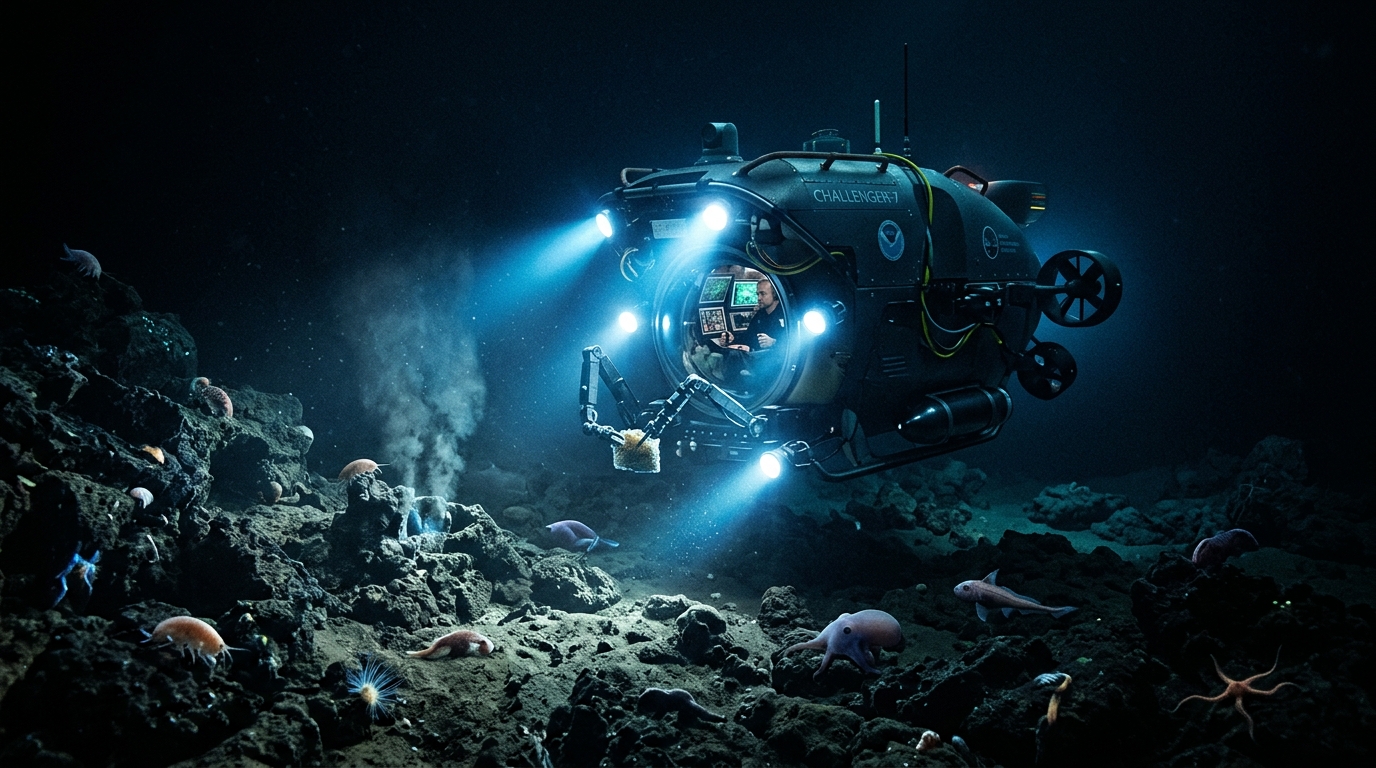
The primary vehicle for unlocking the secrets of the Hadal Zone has been specialized deep-sea technology. The crushing pressures demand extraordinary engineering. The Trieste made history in 1960 as the first crewed vessel to reach the bottom of the Challenger Deep. Decades later, modern submersibles like the Deepsea Challenger, piloted by James Cameron in 2012, and advanced autonomous underwater vehicles (AUVs) have mapped the trench floors in unprecedented detail. These futuristic vessels use syntactic foam for buoyancy and thick titanium spheres to protect the human occupants or sensitive electronics from the immense hydrostatic pressure, functioning essentially as reverse spaceships exploring inner space.
Further Reading & References
- NOAA Ocean Exploration: The Hadal Zone
- Woods Hole Oceanographic Institution (WHOI): Deep Ocean Exploration
- Marine Technology Society Journal: Advances in Hadal Science and Technology