A Window to the Universe
When the Space Shuttle Discovery roared into the Florida sky on April 24, 1990, carrying the Hubble Space Telescope into orbit, few could have predicted the profound cultural and scientific impact the instrument would have on humanity. For millennia, our ancestors looked up at the night sky through the murky, turbulent lens of Earth’s atmosphere. Even the most powerful ground-based telescopes were limited by this atmospheric distortion, which blurred the light of distant stars and galaxies, rendering the deepest corners of the cosmos largely invisible.
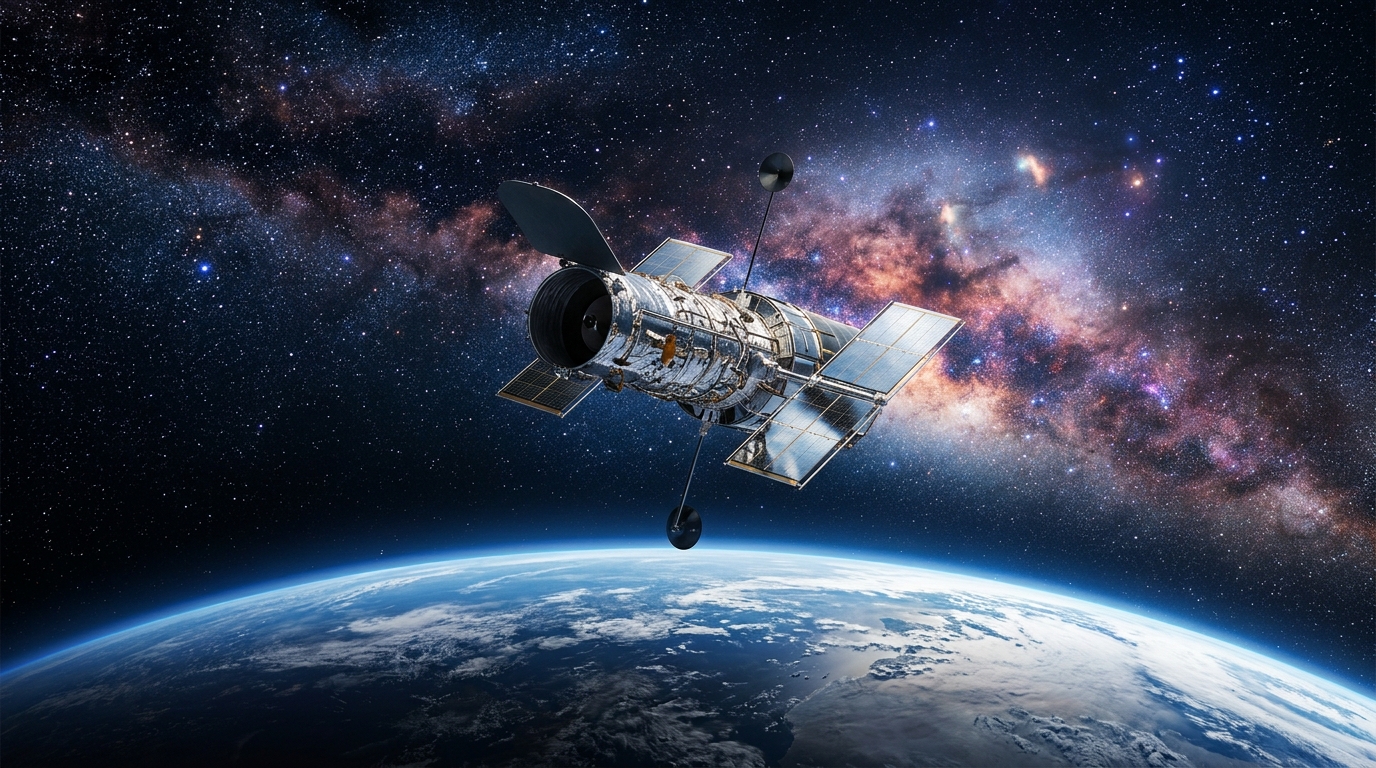
Hubble changed everything. By operating in low Earth orbit at an altitude of approximately 480 kilometers, well above the distorting effects of our atmosphere, Hubble was able to capture the cosmos with unprecedented clarity. The Great Observatory, named in honor of the pioneering astronomer Edwin Hubble—who first discovered that the universe is expanding—has spent the last 35 years acting as humanity’s premier cosmic eye.
With its 2.4-meter (7-foot, 10-inch) primary mirror, it detects light across ultraviolet, visible, and near-infrared wavelengths. Over its remarkable operational lifespan, Hubble has gathered an astonishing amount of data, transforming our understanding of the cosmos and bringing the stark beauty of the universe into the living rooms of millions around the globe.
“Hubble didn’t just change astronomy; it changed how humanity sees its place in the universe. We went from a blurry, speculative understanding of galaxies to seeing them in crisp, awe-inspiring detail.” — CosmoTerra Science Dispatch
The Servicing Missions: A Telescope Reborn
Despite its legendary status today, Hubble’s journey began with a near-catastrophic setback. Shortly after its deployment, scientists analyzing the telescope’s first images noticed a devastating flaw: the pictures were out of focus. An investigation revealed a microscopic error in the shaping of Hubble’s primary mirror. The edges of the mirror were too flat by a mere 2.2 micrometers—roughly 1/50th the thickness of a human hair. This phenomenon, known as spherical aberration, meant that the telescope could not focus all the light it collected into a single, sharp point.
The scientific community was devastated, and Hubble briefly became the subject of intense public scrutiny. However, because Hubble was designed from the ground up to be serviced in space by astronauts, the mission was far from lost.
In December 1993, the crew of the Space Shuttle Endeavour embarked on STS-61, the first of what would become five historic servicing missions. Over the course of five grueling spacewalks, astronauts installed the Corrective Optics Space Telescope Axial Replacement (COSTAR) instrument. COSTAR acted like a pair of high-tech eyeglasses for Hubble, perfectly compensating for the mirror’s flaw. When the first post-repair images were beamed back to Earth, they were razor-sharp. Hubble’s true vision had finally been unlocked.
Subsequent servicing missions in 1997, 1999, 2002, and 2009 continued to upgrade the telescope. Astronauts replaced aging gyroscopes, installed upgraded batteries, and added state-of-the-art instruments like the Wide Field Camera 3 (WFC3) and the Cosmic Origins Spectrograph (COS). These upgrades not only kept Hubble alive but made it significantly more powerful than when it originally launched, extending its life far beyond its initial 15-year estimate.
Revolutionary Cosmic Discoveries
The numbers behind Hubble’s scientific output are staggering. As it marks its 35th anniversary, the telescope has made over 1.7 million observations of more than 53,000 astronomical objects. These observations have fueled more than 23,000 peer-reviewed scientific papers, making Hubble one of the most productive scientific instruments ever built. Its impact spans almost every conceivable sub-field of astrophysics:
1. The Accelerating Universe and Dark Energy
Perhaps Hubble’s most profound and unexpected contribution was its role in studying distant supernovae. In the late 1990s, two independent teams of astronomers used Hubble (along with ground-based telescopes) to observe Type Ia supernovae—exploding white dwarf stars that serve as “standard candles” for measuring cosmic distances. The data revealed something shocking: the expansion of the universe was not slowing down due to gravity, as widely assumed, but was actually accelerating. This discovery led to the Nobel Prize-winning realization that a mysterious, repulsive force known as dark energy makes up roughly 68% of the universe.
2. Refining the Hubble Constant
Before Hubble’s launch, estimates of the universe’s age varied wildly, ranging anywhere from 10 to 20 billion years. By meticulously tracking Cepheid variable stars in distant galaxies, Hubble helped astronomers nail down the “Hubble Constant”—the exact rate of cosmic expansion. This critical measurement effectively ended decades of intense scientific debate, allowing astrophysicists to confidently calculate the age of the universe at 13.8 billion years.
3. The Deep Fields: Looking Back in Time
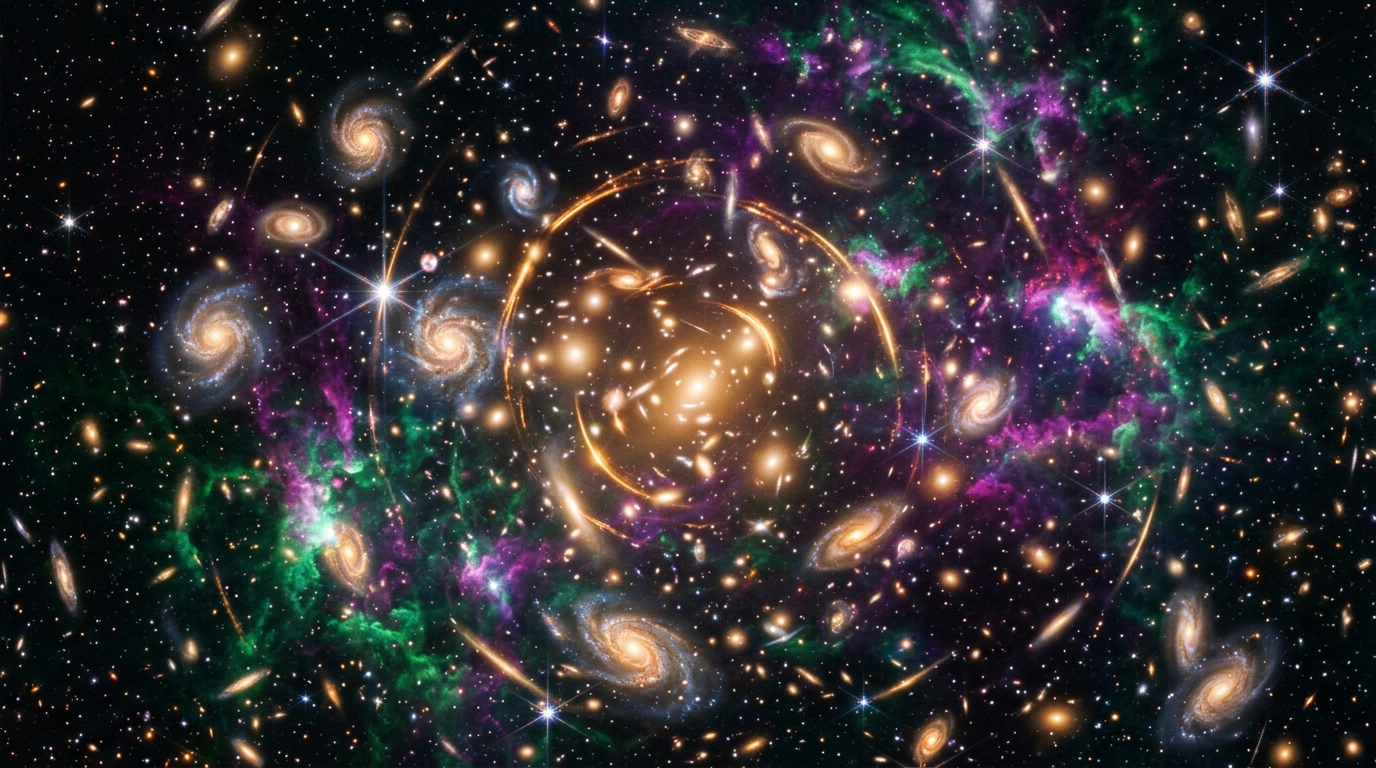
In 1995, the Hubble director made a controversial decision: to point the telescope at a seemingly empty, dark patch of sky in the constellation Ursa Major, and leave it there for ten consecutive days. The result was the Hubble Deep Field. Instead of an empty void, the image revealed a dazzling jewel box of over 3,000 galaxies, some of which existed when the universe was only a billion years old. Later follow-ups, such as the Ultra Deep Field and Extreme Deep Field, pushed the boundary even further, capturing light from objects over 13.4 billion light-years away, offering a direct look back to the cosmic dawn.
4. Exoplanet Atmospheres
Long before the James Webb Space Telescope (JWST) took to the skies to characterize alien worlds, Hubble was already blazing the trail. Though not originally designed to study exoplanets—the first exoplanet wasn’t even discovered until after Hubble launched—the telescope successfully analyzed the atmospheres of planets orbiting distant stars. It achieved a series of “firsts,” including the first detection of an exoplanet atmosphere (detecting sodium on HD 209458 b) and analyzing extreme weather systems and atmospheric compositions on hot Jupiters.
The Pillars of Creation and Beyond
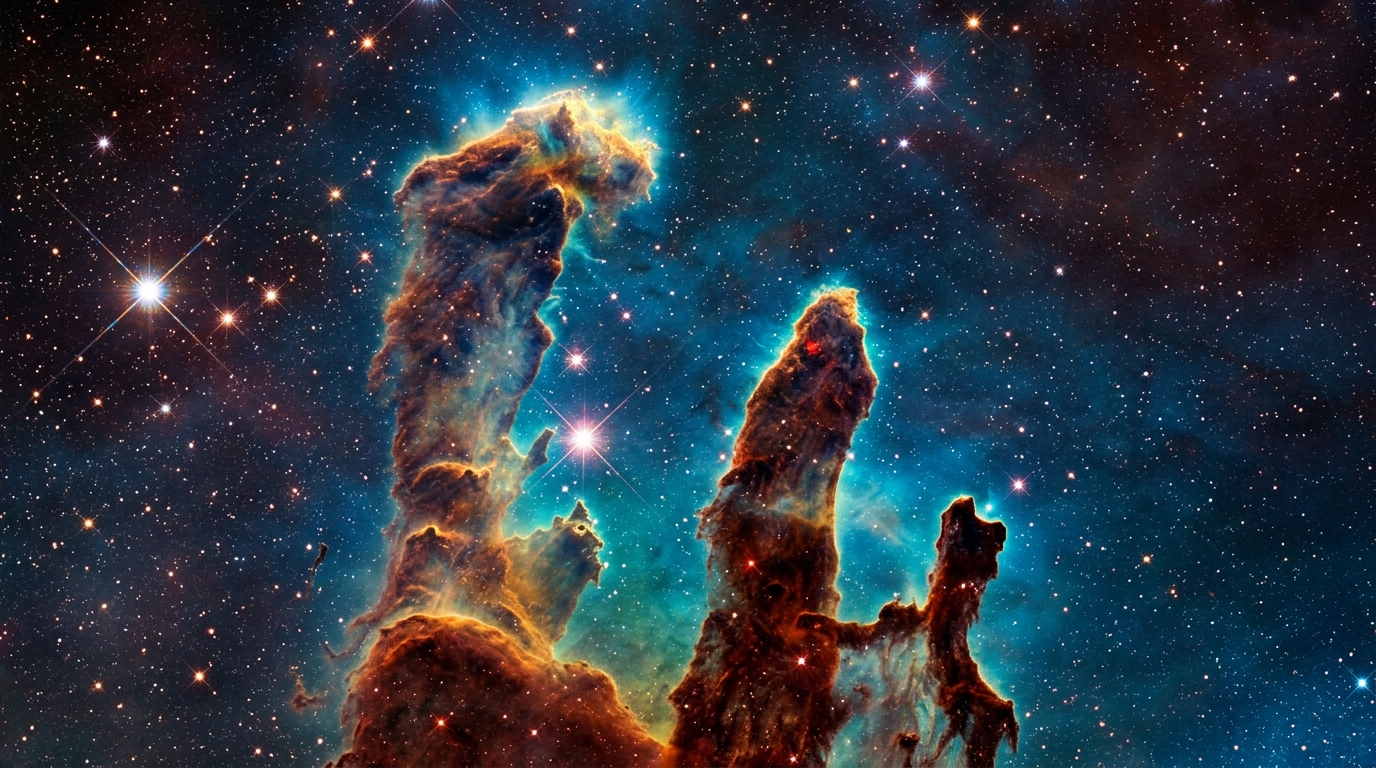
While the data Hubble provides is invaluable to scientists, its cultural legacy is cemented by its imagery. No photograph defines this legacy quite like the “Pillars of Creation.” Captured in 1995 (and revisited with upgraded cameras in 2014), the image showcases a towering structure of interstellar gas and dust in the Eagle Nebula, roughly 6,500 light-years from Earth.
The image is a masterpiece of cosmic destruction and rebirth. Deep within the dense, opaque dust of the pillars, newborn stars are igniting. As they roar to life, their intense ultraviolet radiation slowly erodes the very pillars of gas that birthed them. It is a stunning visual representation of the life cycle of the universe, and it became an instant cultural touchstone, appearing on everything from magazine covers to coffee mugs. It proved that science and art are not mutually exclusive; the universe is inherently beautiful.
An Enduring Cosmic Legacy
Today, Hubble no longer works alone. It frequently collaborates with the James Webb Space Telescope, combining Hubble’s mastery of the ultraviolet and visible spectrums with JWST’s unmatched infrared capabilities. Together, they provide a more complete, multi-wavelength view of the universe than ever before.
Even as Hubble enters the twilight of its operational life—its orbit slowly decaying and its gyroscopes showing their age—its legacy is secure. It has answered questions humanity has asked for millennia and raised new mysteries we hadn’t even conceived of. The Mikulski Archive for Space Telescopes holds nearly 200 terabytes of science-ready data from Hubble, ensuring that new generations of astronomers will continue making discoveries from its observations for decades to come.
Hubble remains a soaring monument to human curiosity, forever changing the way we look up at the night sky.
Further Reading & References
- NASA Hubble Space Telescope Mission Page: Hubble 35th Anniversary Highlights
- Space Telescope Science Institute (STScI): The Mikulski Archive for Space Telescopes
- European Space Agency (ESA): Hubble’s Greatest Discoveries