The Phantom of the Canopy
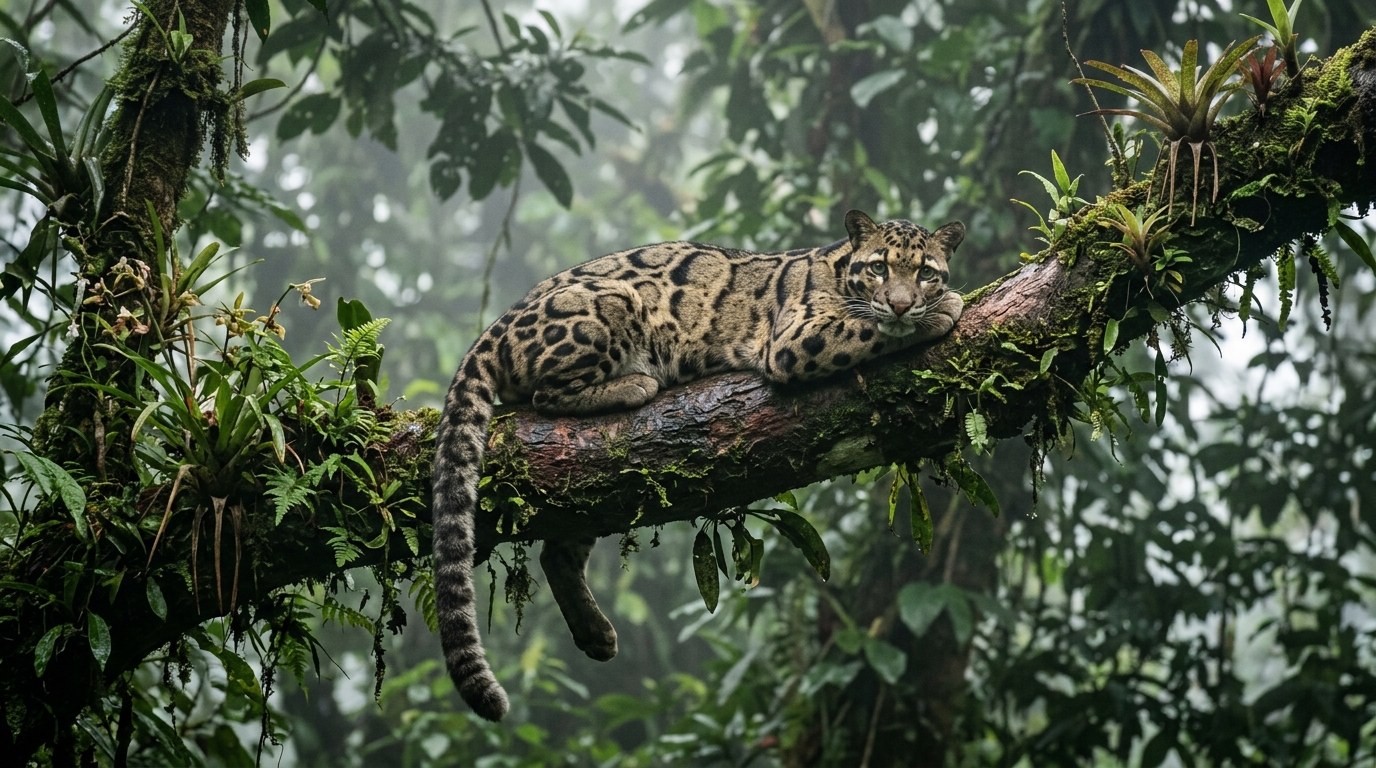
Deep within the dense, humid rainforests of Southeast Asia, ranging from the foothills of the Himalayas to the dense jungles of Borneo and Sumatra, stalks a predator so elusive it is rarely seen by human eyes. Shrouded in striking, cloud-like rosettes that provide perfect camouflage against the dappled light of the forest floor, the Clouded Leopard (Neofelis nebulosa) is one of nature’s most extraordinary and least understood wild cats.
Despite its name, the clouded leopard is not a true leopard. It belongs to its own distinct evolutionary lineage, serving as an evolutionary bridge between the “big cats” (lions, tigers, jaguars, true leopards) in the genus Panthera and the smaller feline species.
It is a medium-sized cat, typically weighing between 25 to 50 pounds (11 to 22 kg), but what it lacks in massive bulk, it makes up for with highly specialized anatomy that makes it an undisputed master of the trees.
“The clouded leopard is an evolutionary masterpiece, built for a life suspended in the canopy. It is the closest thing the modern world has to a saber-toothed cat.” — CosmoTerra Science Dispatch
Anatomical Marvels: Built for the Trees
While many cats can climb trees to escape danger or rest, the clouded leopard is built for an arboreal life. It spends a vast amount of its time in the forest canopy, navigating treacherous heights with breathtaking agility. Several unique physical adaptations make this possible:
1. Flexible Ankles and Head-First Descents
The most astonishing adaptation of the clouded leopard is its remarkable ankle flexibility. The joints in their hind ankles can rotate almost completely backward. This allows them to grip branches tightly with their hind claws while hanging completely upside down. It also grants them a rare ability among felines: they can climb down tree trunks head-first, much like a squirrel.
2. The Balancing Tail
A clouded leopard’s tail can be incredibly long—often as long as its entire body. This thick, heavy tail acts as a crucial counterbalance, allowing the cat to make precise, acrobatic leaps from branch to branch and navigate narrow limbs without losing its footing.
3. Low Center of Gravity and Large Paws
They have remarkably short, stout legs compared to other wild cats, which lowers their center of gravity and increases stability when moving through the canopy. Their paws are exceptionally large and broad, equipped with sharp claws, acting like climbing grips that provide immense traction on slippery bark.
The Modern Saber-Tooth
Perhaps the most striking feature of the clouded leopard is its dental anatomy. Relative to its skull size, the clouded leopard possesses the longest canine teeth of any living feline species. Their canines can measure up to 2 inches (5 cm) long. For a cat that weighs roughly the same as a medium-sized dog, these teeth are disproportionately massive.
Because of these elongated canines and a jaw that can open to a remarkably wide 100 degrees (compared to a domestic cat’s 65 degrees), scientists often draw comparisons between the clouded leopard and the extinct saber-toothed cats, such as Smilodon.
These formidable teeth are designed to deliver a deep, fatal bite to the back of the neck of their prey, severing the spinal cord instantly. Their diet is diverse, consisting of arboreal animals like macaques, gibbons, and birds, as well as terrestrial prey they ambush from above, including small deer, wild boars, and porcupines.
The Sunda Clouded Leopard
For decades, the clouded leopard was considered a single species. However, in 2006, genetic analysis revealed a major surprise: the clouded leopards living on the islands of Borneo and Sumatra are actually a completely separate species, now known as the Sunda Clouded Leopard (Neofelis diardi).
The Sunda clouded leopard has a darker coat, smaller cloud markings, and distinct genetic differences that suggest the two species diverged over 1.5 million years ago. This discovery highlighted how much we still have to learn about these secretive predators.
A Vulnerable Future
Because they are so elusive and primarily active at night (nocturnal) or at twilight (crepuscular), studying clouded leopards in the wild is notoriously difficult. Researchers rely heavily on motion-activated camera traps to gather data on their populations and behaviors.
Tragically, what data we do have indicates a species in peril. The clouded leopard is classified as Vulnerable by the IUCN, and the Sunda clouded leopard is considered Endangered. The primary threats they face are entirely human-driven:
- Habitat Loss: The rapid deforestation of Southeast Asia for logging, agriculture, and sprawling palm oil plantations has severely fragmented their rainforest homes. As arboreal specialists, they cannot survive in deforested landscapes.
- Poaching: They are illegally hunted for their beautiful pelts, and their bones and teeth are trafficked for use in traditional medicines.
Conservation efforts are underway, focusing on protecting critical forest corridors, establishing anti-poaching patrols, and captive breeding programs. However, saving the clouded leopard requires a concerted global effort to halt the destruction of the ancient rainforests they call home. If we lose the forests, we lose the phantom of the canopy forever.
Masters of Stealth and Ambush
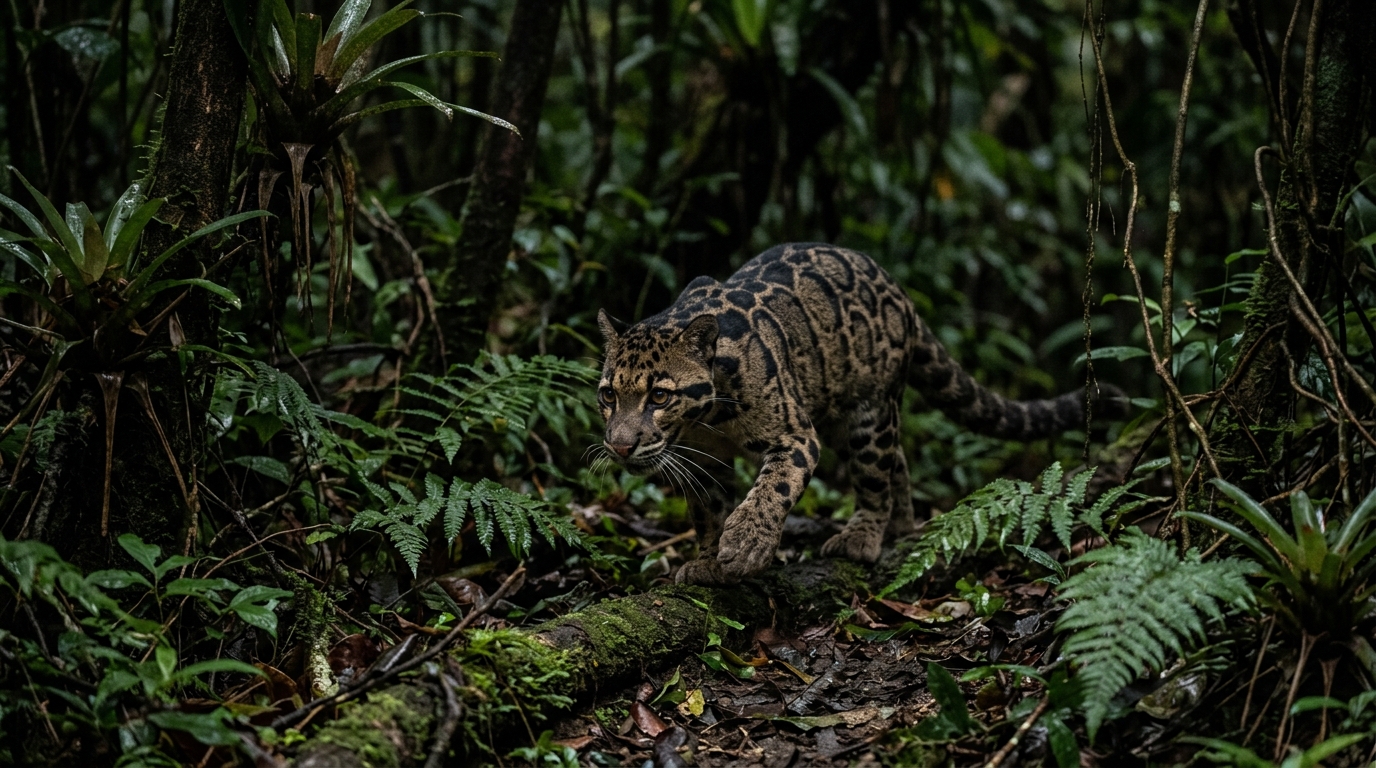
The clouded leopard’s breathtaking physical adaptations are perfectly matched by its hunting strategy. As an ambush predator, it relies heavily on stealth and its incredible climbing abilities. Unlike cheetahs that run down prey or lions that hunt in coordinated prides, the clouded leopard is a solitary hunter that uses the three-dimensional space of the rainforest to its advantage.
They are known to stalk prey terrestrially but frequently use trees as vantage points. They will wait silently on low-hanging branches, blending perfectly with the foliage thanks to their large, irregular rosettes, before dropping down onto unsuspecting terrestrial prey such as small deer or wild boars. Their enormous canines and powerful jaws ensure a swift, lethal bite, minimizing the chance of the prey escaping or fighting back. This combination of arboreal agility and devastating terrestrial strikes makes them one of the most versatile apex predators in their ecosystem.
Further Reading & References
- World Wildlife Fund (WWF): Clouded Leopard Conservation
- San Diego Zoo Wildlife Alliance: Clouded Leopard Facts
- IUCN Red List: Neofelis nebulosa species profile