Into the Stygian Abyss
Beneath the sunlit turquoise shallows where coral reefs thrive lies an unfathomable realm: the Hadopelagic zone, named after Hades, the ancient Greek underworld. At depths surpassing 6,000 meters, sunlight has long ceased to exist. Yet, in this perpetual midnight, the ocean floor is anything but dark.
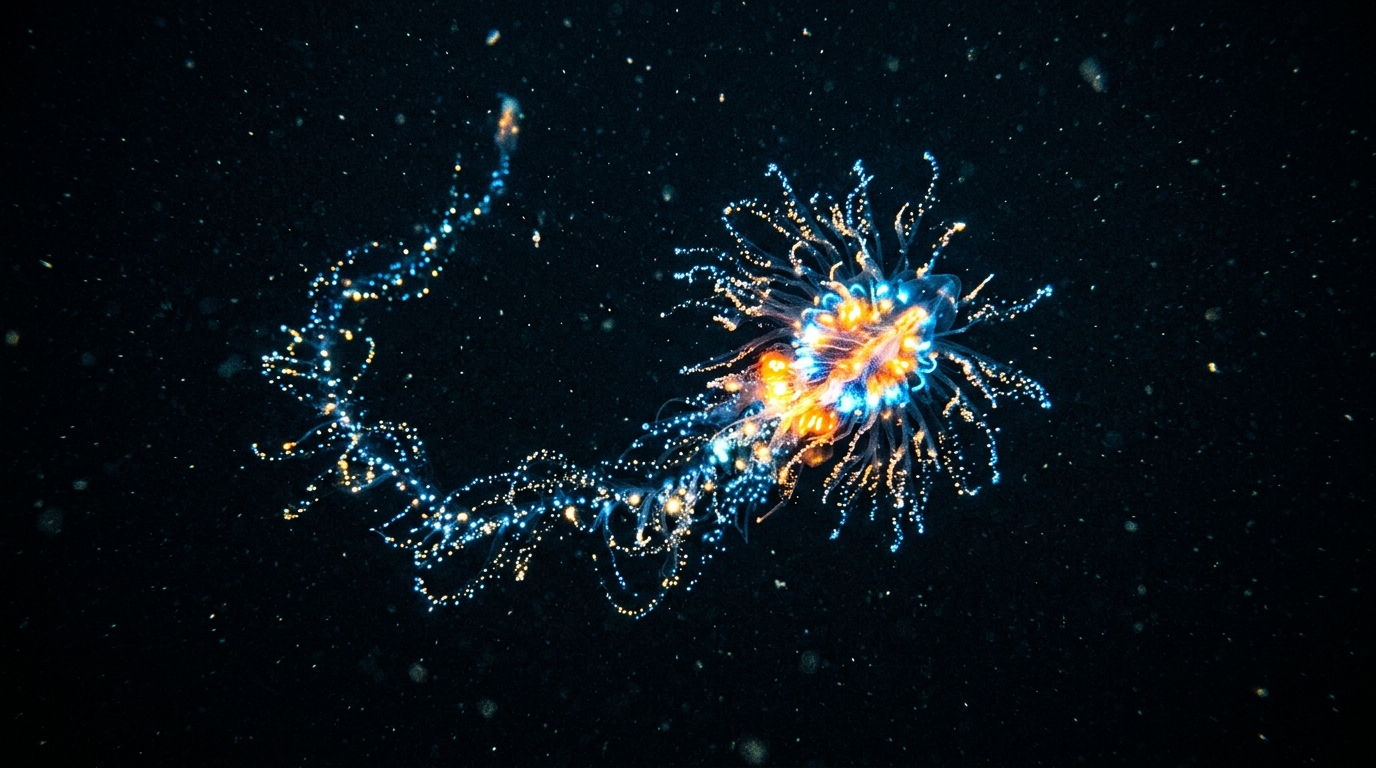
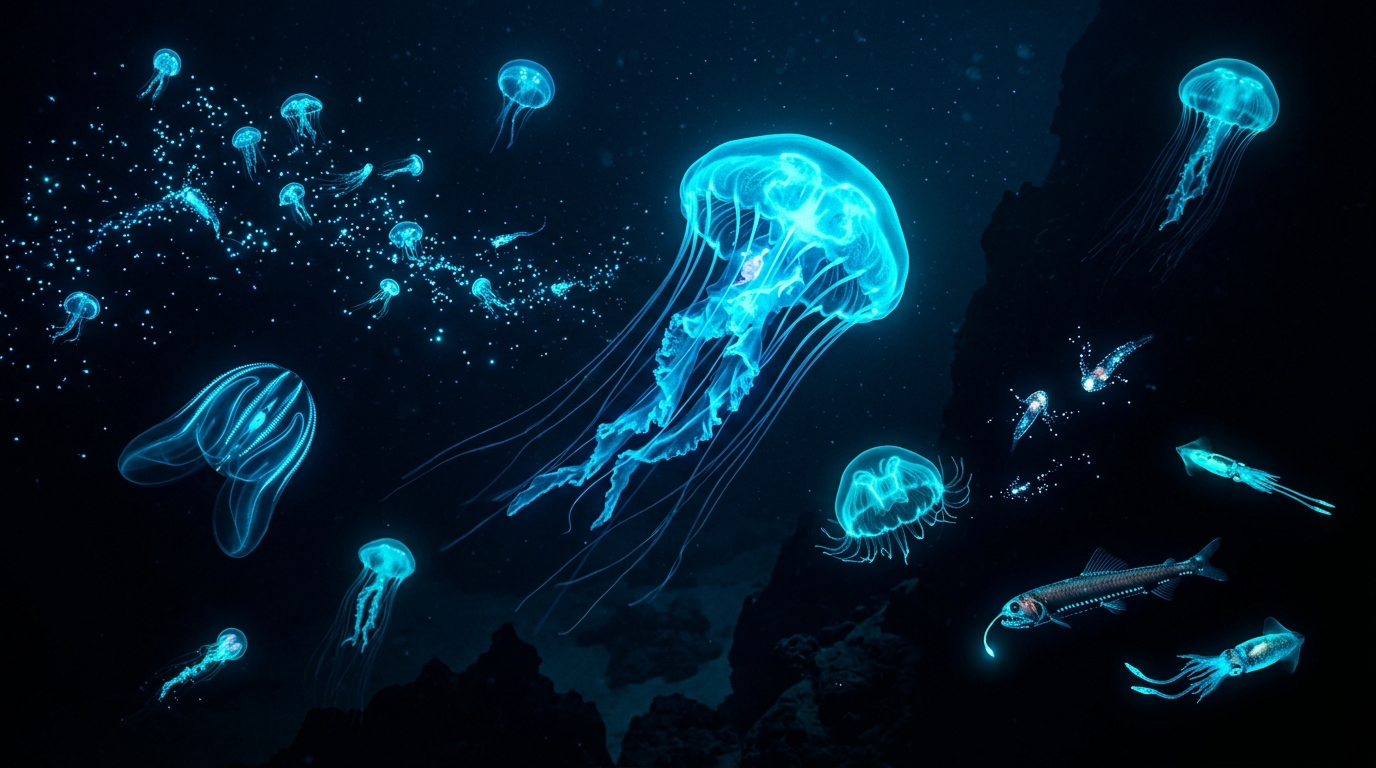
Through submersibles fitted with ultra-sensitive low-light sensors, oceanographers encounter an ethereal light show. Bioluminescent comb jellies (Ctenophora), dragonfish with luminescent teeth, and siphonophores measuring tens of meters drift through the abyssal currents like living constellations.
“To witness bioluminescence in the Mariana Trench is to realize that cold light does not belong exclusively to distant stars; the deepest abyss has crafted its own living galaxy.” — CosmoTerra Science Dispatch
[0m] Surface Zone ── Sunlight & Phytoplankton
  ↓
[200m - 1,000m] Twilight Zone ── Dim Blue Photons
  ↓
[1,000m - 4,000m] Midnight Zone ── 100% Perpetual Darkness
  ↓
[4,000m - 11,000m] Abyssal & Hadal Plains ── Chemical Bioluminescence
The Chemistry of Cold Light
Unlike thermal light sources that generate waste heat, marine bioluminescence is an exceptionally efficient chemical reaction. It involves two primary biochemical components:
- Luciferin: A light-emitting substrate molecule.
- Luciferase: An enzyme that catalyzes the oxidation of luciferin in the presence of co-factors such as magnesium and ATP.
In the deep ocean, the predominant color emitted is blue-green (wavelength ~470 nm). This wavelength travels furthest through dense seawater, allowing organisms to signal mates, lure prey, or confuse predators with glowing decoy clouds.
| Function | How It’s Used | Example Organism |
|---|---|---|
| Counter-illumination | Ventral light matches faint downwelling sunlight to erase the animal’s silhouette | Hatchetfish, lanternfish |
| Predatory Lure | A glowing appendage mimics prey to draw victims within striking range | Anglerfish (esca) |
| Startle & Escape | A sudden bright flash disorients an attacking predator | Deep-sea shrimp, some squid |
| Decoy Cloud | Luminous ink or mucus is expelled to distract predators while the animal flees | Vampire squid, ostracods |
Specialized Survival Adaptations
To survive crushing pressures exceeding 1,000 atmospheres, hadal organisms exhibit remarkable biochemical specializations:
- Piezo-stabilizing osmolytes: Elevated concentrations of trimethylamine N-oxide (TMAO) that stabilize cellular proteins against pressure denaturation.
- Flexible Cartilaginous Frameworks: Absence of brittle rigid bones and air-filled cavities that would implode under hadal pressures.
- Counterillumination Photophores: Ventral light organs that match ambient downwelling photons, rendering animals silhouette-free to predators below.
Oceanic Vents and the Origin of Life
Surrounding the Mariana Trench are deep-sea hydrothermal chimneys known as “black smokers.” Spewing superheated, mineral-dense fluids at temperatures over 350°C, these vents support ecosystems powered entirely by chemosynthetic bacteria, forming an ecological web completely independent of solar photosynthesis that reflects the geochemical environments where life on Earth likely began.
Further Reading & References
- NOAA Ocean Exploration: Mariana Trench Expeditions & Hadal Science — Submersible video archives and bathymetric mapping.
- Woods Hole Oceanographic Institution (WHOI): Hadal Zone Ecosystems & Bioluminescence — Research into deep-sea biochemical adaptations.
- Monterey Bay Aquarium Research Institute (MBARI): The Deep Sea: Light in the Darkness — High-definition imaging of midwater ctenophores and siphonophores.