The Sleeping Giant of Wyoming
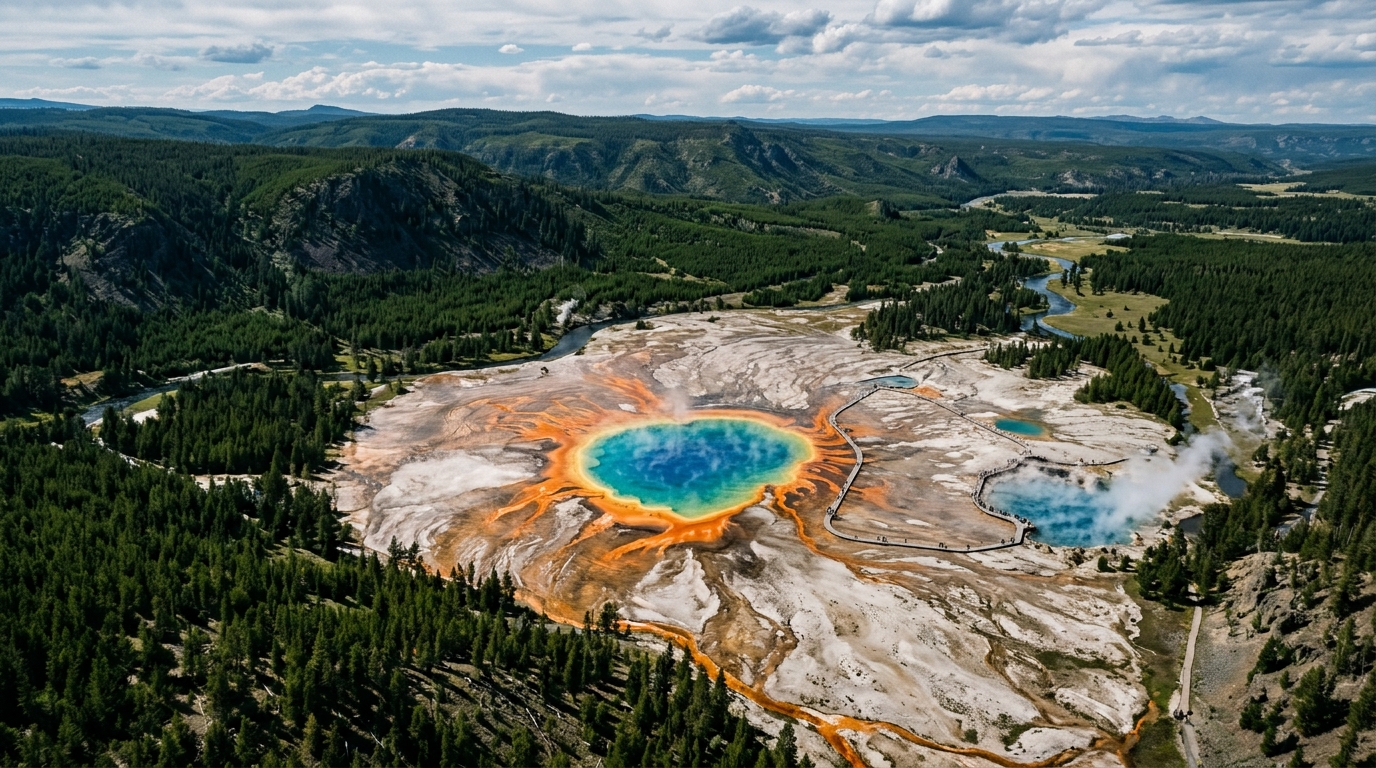
Yellowstone National Park is celebrated worldwide for its breathtaking landscapes, abundant wildlife, and, most notably, its spectacular hydrothermal features. Old Faithful erupting against a crisp blue sky, the vibrant prismatic colors of the Grand Prismatic Spring, and bubbling mud pots all draw millions of visitors each year.
However, these mesmerizing surface features are merely the exhaust valves for a terrifying geological reality. The entirety of Yellowstone National Park sits atop one of the largest active volcanic systems on Earth—a true supervolcano.
Unlike classic, cone-shaped volcanoes such as Mount Fuji or Mount St. Helens, Yellowstone’s volcano doesn’t look like a mountain at all. It is a massive depression in the ground, measuring roughly 34 by 45 miles (55 by 72 kilometers), known as a caldera. This immense crater was left behind after the volcano literally blew its top off in a catastrophic eruption hundreds of thousands of years ago, collapsing in on itself.
“Yellowstone is a reminder that Earth is a dynamic, living planet with geological forces operating on a scale that dwarfs human comprehension.” — CosmoTerra Science Dispatch
The Mechanics of a Supervolcano
What makes a volcano a “supervolcano”? The classification is based on the Volcanic Explosivity Index (VEI). A supervolcano is one that has had at least one eruption measuring VEI-8, meaning it released more than 1,000 cubic kilometers (240 cubic miles) of volcanic material. To put that in perspective, the devastating 1980 eruption of Mount St. Helens released only about 1 cubic kilometer of material. A Yellowstone supereruption would be thousands of times more powerful.
Yellowstone is fueled by a mantle plume or “hotspot”—a stationary column of incredibly hot, upwelling magma originating deep within the Earth’s mantle. As the North American tectonic plate slowly drifts southwest over this stationary hotspot (at a rate of about an inch per year), the magma punches through the crust, creating a trail of ancient, extinct calderas stretching across Idaho and Nevada, leading up to the current active caldera in Wyoming.
Beneath Yellowstone lies a two-tiered magma system.
- The Upper Chamber: Located 3 to 10 miles (5 to 16 km) beneath the surface, filled mostly with sticky, highly viscous rhyolite magma.
- The Lower Reservoir: Sitting 12 to 30 miles (20 to 48 km) deep, filled with hotter, denser basaltic magma.
It is this shallow upper chamber, largely solid but containing pockets of molten rock and intensely pressurized gases, that heats the groundwater to create the park’s famous geysers and hot springs.
The History of Eruptions
Yellowstone has experienced three massive, caldera-forming supereruptions in its geological past:
- The Huckleberry Ridge Eruption (2.1 million years ago): The largest of the three, releasing a staggering 2,450 cubic kilometers of volcanic material.
- The Mesa Falls Eruption (1.3 million years ago): The smallest of the three, but still massive, releasing 280 cubic kilometers of material.
- The Lava Creek Eruption (631,000 years ago): Released roughly 1,000 cubic kilometers of material and created the caldera we see today.
If you look at the math, these eruptions occurred roughly 800,000 and 660,000 years apart. Given that the last eruption was 631,000 years ago, a popular myth has emerged that Yellowstone is “overdue” for an eruption.
The Question of “When”: Are We Overdue?
The short answer is no. Volcanoes do not operate on a strict timetable or a clock.
The idea that Yellowstone is “overdue” is based on the average interval between the three major eruptions (about 730,000 years). However, three data points do not make a statistically reliable trend. Furthermore, even if volcanoes did operate on a schedule, we would still have nearly 100,000 years left before hitting that average mark.
More importantly, scientists from the Yellowstone Volcano Observatory (YVO), a consortium involving the USGS and various universities, constantly monitor the park using a vast network of seismometers, GPS stations, and satellite imagery. They track ground deformation (the ground in Yellowstone slowly rises and falls, “breathing” as magma and fluids move underground) and seismic activity (Yellowstone experiences 1,500 to 2,500 small earthquakes annually).
Current data indicates that the magma reservoir beneath Yellowstone is only about 5% to 15% molten. For a supereruption to occur, a magma chamber typically needs to be at least 50% molten to mobilize the necessary volume of rock and gas.
What If It Did Erupt?
While highly unlikely in our lifetimes, what would happen if Yellowstone were to experience a VEI-8 supereruption today? The consequences would be globally catastrophic.
- The Immediate Zone: Everything within a roughly 50-mile radius of the park would be destroyed by pyroclastic flows—superheated avalanches of gas, ash, and rock travelling at hurricane speeds.
- Ash Fall: A massive umbrella cloud of ash would blanket the United States. Cities in the Midwest could see feet of ash, collapsing roofs, grounding all air travel, shorting out electrical grids, and devastating agriculture. Breathing the silica-rich ash would be lethal.
- Global Climate Change: The eruption would inject immense quantities of sulfur dioxide aerosols into the stratosphere. These aerosols would reflect sunlight away from the Earth, triggering a “volcanic winter.” Global temperatures could drop dramatically for years, disrupting global weather patterns and causing massive agricultural failures worldwide.
A Watched Pot
While the destructive potential is terrifying, the reality is reassuring. Yellowstone is one of the most closely monitored geological sites on the planet. Any buildup to a major eruption—such as a massive increase in earthquake swarms, rapid ground uplift, or significant changes in geothermal activity—would likely take decades or centuries to unfold, giving humanity ample warning.
For now, the sleeping giant slumbers, harmlessly venting its immense heat through the beautiful geysers that continue to captivate the world.
Hydrothermal Features: The Volcano’s Breath
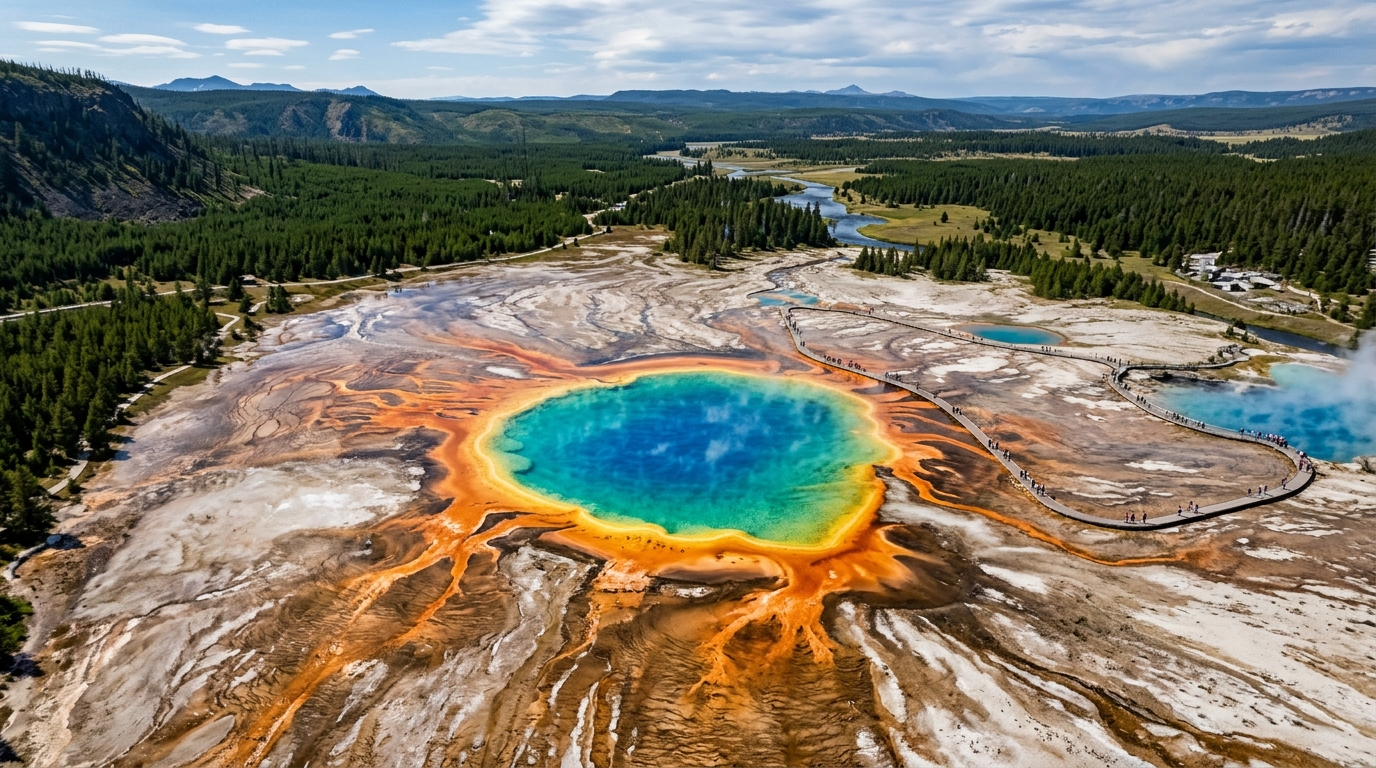
While the magma chamber slumbers deep underground, its immense heat powers the vibrant hydrothermal features on the surface, which serve as beautiful, visible indicators of the volcano’s activity. Yellowstone is home to more than 10,000 hydrothermal features, including half of the world’s active geysers.
The most iconic of these is the Grand Prismatic Spring, the largest hot spring in the United States. Its stunning rainbow coloration—vibrant rings of orange, yellow, and green surrounding a deep azure center—is the result of thermophilic (heat-loving) bacteria thriving in the extreme temperatures of the mineral-rich water. These surface features are not just tourist attractions; they are closely monitored by geologists. Significant changes in the temperature, chemistry, or eruption frequency of these geysers can provide crucial data about the movement of fluids and magma deep within the Earth’s crust.
Further Reading & References
- USGS Yellowstone Volcano Observatory: Current Alerts and Monitoring
- National Park Service: Yellowstone Geology
- Smithsonian Global Volcanism Program: Yellowstone Profile