The Phantom of the Roof of the World
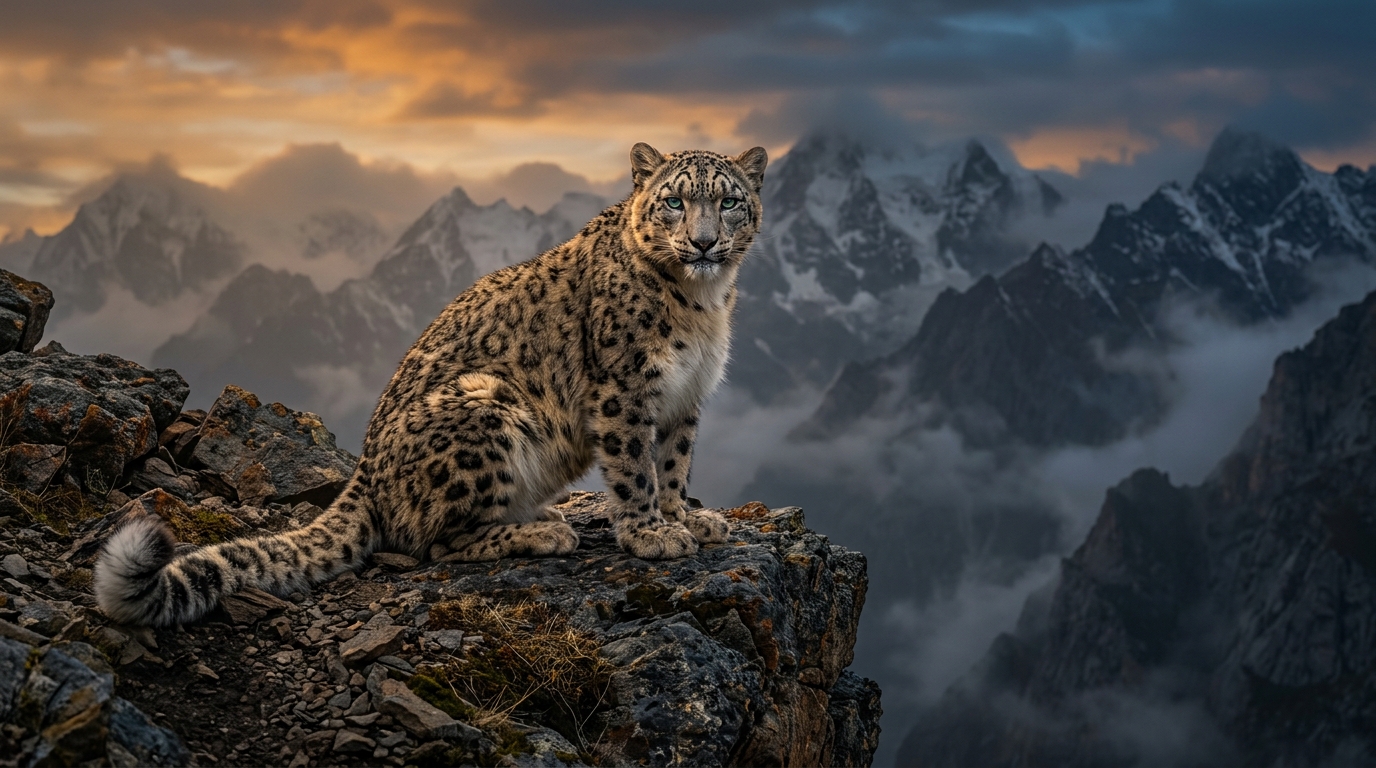
High in the craggy ridgelines of Central Asia—spanning the Himalayas, Karakoram, and Hindu Kush ranges—lives a creature rarely seen by human eyes. Nicknamed the Shan by Tibetan communities or the “Ghost of the Mountains,” the snow leopard (Panthera uncia) thrives in an environment that would prove lethal to most terrestrial mammals.
At altitudes exceeding 5,000 meters, temperatures routinely plummet below -40°C, and atmospheric oxygen is roughly half that of sea level.
“To observe a snow leopard dissolve seamlessly into fractured granite cliffs is to witness evolutionary mastery over one of the planet’s harshest ecosystems.” — CosmoTerra Science Dispatch
Evolutionary Adaptations to Extreme Altitude
The snow leopard possesses an array of biological adaptations specifically refined for high-altitude survival:
| Adaptation | Physical Trait | Survival Benefit |
|---|---|---|
| Enlarged Nasal Cavities | Deep chest and expanded sinus passages | Warms and humidifies sub-zero air, maximizing oxygen transfer |
| Dense Multilayered Pelage | Several inches of insulating fur along the belly | Traps warm air and provides smoky-gray camouflage against rock |
| Broad Snowshoe Paws | Wide, fur-cushioned paws | Distributes weight on snowdrifts and muffles footsteps |
| Heavy Balancing Tail | Nearly body-length, muscular tail | Acts as a counterweight for leaps and a thermal wrap while resting |
Conservation in the Modern Era
As glacial retreat accelerates and human pastoralism extends into alpine valleys, snow leopard ranges face increasing fragmentation. Modern conservation projects rely on community-managed predator-proof corrals, camera-trap telemetry, and non-invasive genetic surveys to safeguard this apex steward of high Asia.
Further Reading & References
- Snow Leopard Trust: Ecology, Behavior & Conservation Status — Global telemetry studies and community-based conservation initiatives.
- IUCN Red List: Panthera uncia Species Assessment — Population modeling, range distribution, and conservation priorities.
- World Wildlife Fund (WWF): Securing Snow Leopard Landscapes — High-altitude climate resilience and biodiversity corridors.